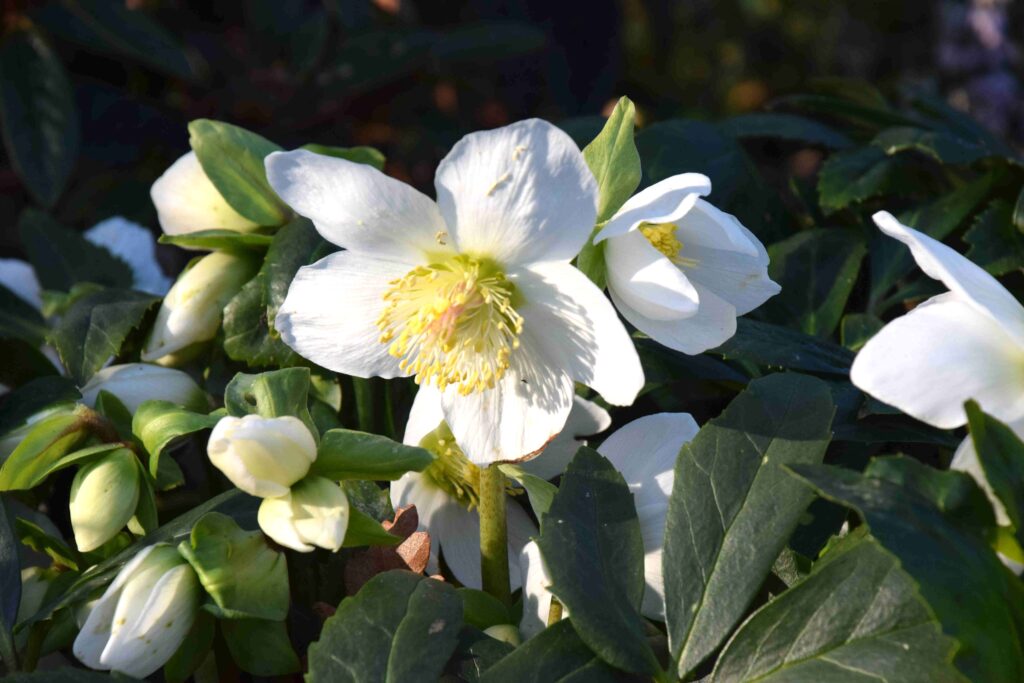
Helleborus niger is popularly called the Christmas rose but, of course, it is not a rose, nor anything to do with roses. But the flowers are vaguely rose-like and it can bloom in time for Christmas.
Native to central Europe, usually in woodland on alkaline soils, it has long been a feature of British gardens. As long ago as 1636 the herbalist John Gerard wrote ‘It beares Rose-fashioned floures upon slender stems, growing immediately out of the ground an hand-full high, sometimes very white, and oftentimes mixed with a little shew of purple’. He added that ‘the first floureth about Christmasse, if the Winter be milde and warme.’
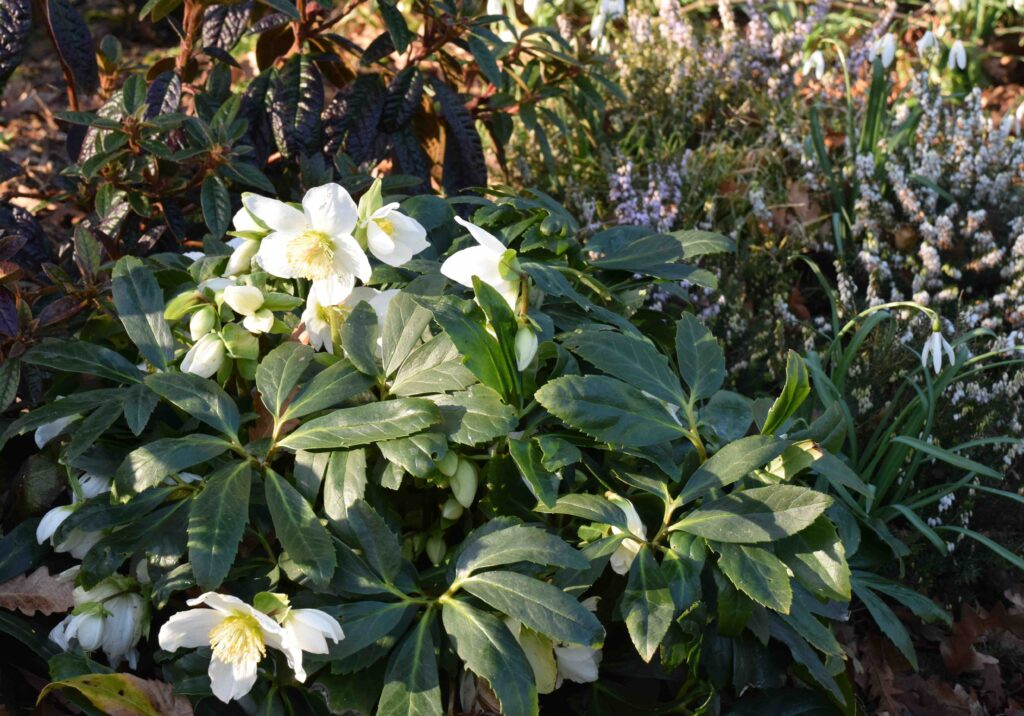
Although it famously bloomed at Christmas, in fact older kinds rarely did and gardeners searched for early-flowering plants. The most cherished kind was ‘Potter’s Wheel’ with large, white flowers but even that did not always bloom for the Festive season and gardeners would cover plants with cloches to hasten bloom and to protect the flowers from being damaged by the weather.
These days things are a lot simpler because we have lots of early-blooming Christmas Roses that are even in flower now. Knights will have ‘Christmas Carol‘ in various sizes and prices for sale now. They are lovely in a window box and make an inexpensive gift for a cool or cold room where a poinsettia would die.
The Christmas rose is possibly not the easiest of the hellebores to grow in the garden. That accolade goes to the spring-blooming Lenten rose (Helleborus x hybridus) and other hybrids. The Christmas rose needs good soil, rich in organic matter, that does not dry out in summer. It also like part shade and, ideally an alkaline (chalky) subsoil. But it is not difficult to please.
The perfect gift
As a gift it is an excellent choice. Your friend can put it in a patio pot to enjoy outside or can keep it in the pot in the home for a few weeks. Remember it is a hardy plant and it will not tolerate high temperatures for long. So keep it in a cool or unheated room, in good light, or on a bright windowsill. Keep it moist and do not let it dry out. To give it more impact, surround it with a ring of ivy or holly or push a white or red candle into the pot and you have a perfect dinner table centrepiece.
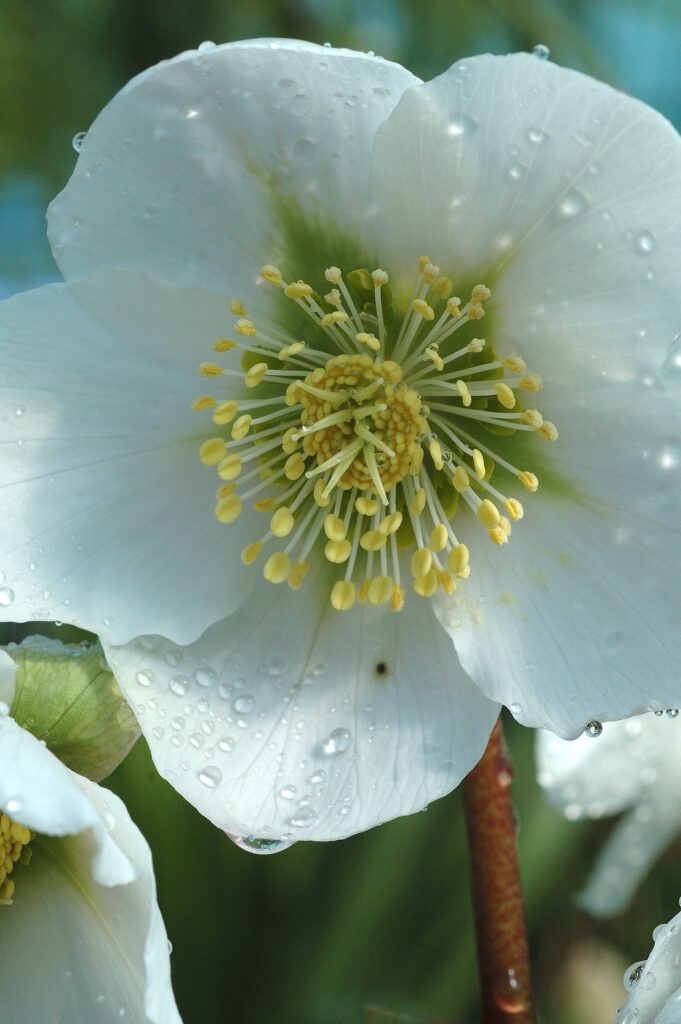
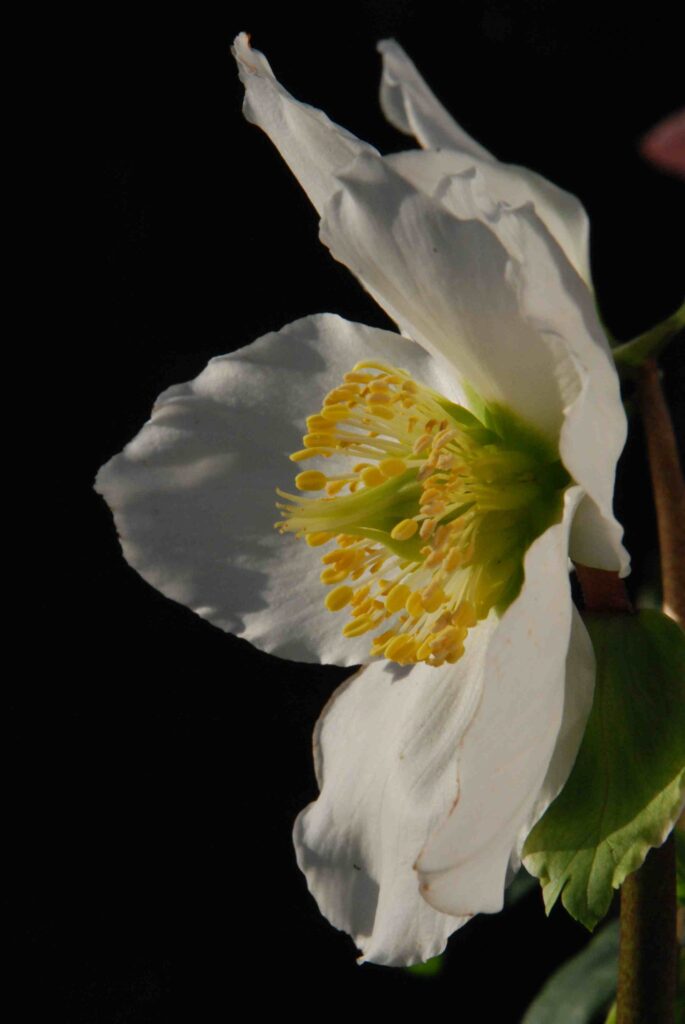
The flowers are made of five or more sepals and as the blooms age they turn green or flushed with red. You can pick them off or leave them to age gracefully.
After a few weeks, plant the Christmas rose in the garden and it should become a permanent part of your winter display.
A favourite with ancient herbalists
Helleborus niger is called the ‘black’ hellebore because of the colour of the roots, not the flowers. ‘Hellebore’ means ‘poisonous food’ and like all hellebores, is poisonous when eaten. This led to its value to old herbalists who used it for various purposes. Gerard wrote that ‘A purgation of Hellebor is good for mad and furious men’. (Note that he seems to have confused what we know as hellebores and veratrum – unrelated plants also called hellebores)
According to legend, in Ancient Greece, King Argos’ daughter was turned mad by the Maenads, women who worshipped Dionysus with ‘ecstatic frenzies’. Hellebore was used to cure her.
Whatever the ancient uses for the plant, it is a lovely permanent addition to the garden or a temporary part of your indoor decor.
Weekly reminders
Plant bare root hedges, trees and fruit
Prune apples, pears and hedges
Sweep up leaves and keep patios clean
Clean up the veg plot, clearing away weeds and old veg plants and fallen brassica leaves
Harvest leeks, parsnips and Brussels sprouts
Bring prepared hyacinths into light and warmth as soon as the shoots show the flowers are through the neck of the bulb